
Mathematics through games is a teaching method that enables children to learn mathematical concepts in a fun way. This method supports children’s mental development by making the abstract structure of numbers, shapes, and operations concrete. Developed especially for preschool and elementary school students, this approach is effective in increasing attention span and making learning permanent.
Mathematics through games is a powerful tool for developing problem-solving skills, learning logical reasoning, and encouraging cooperation. Card games, block-building activities, digital games, and board games with mathematical content support both individual and group learning. This helps children develop a positive relationship with mathematics, making them more interested and motivated in class. In addition, this method allows teachers to conduct a more flexible and effective teaching process according to student differences.
3rd Grade Learning Math with Games
For 3rd grade students, math goes beyond the four operations and becomes a process of developing mental skills. Educational games are a highly effective method for increasing students’ motivation to learn and making mathematical concepts more memorable during this process. Game-based learning allows children to have fun while also developing analytical thinking skills. Mathematical game activities, especially those used in classroom activities, help students focus and improve their operational skills.
Understanding the meaning of numbers is very important in the learning process through games. This is where number discovery games come into play. With these games prepared with colorful blocks, number cards, or digital applications, children discover the relationships between numbers while having fun. In addition, since students can progress at their own pace, these activities also offer the opportunity to individualize the learning process.
Some effective games that can be used in the classroom are listed below:
Addition and subtraction competitions, matching games with number cards
Counting with tens and ones blocks, finding the missing number
Logic boxes, math questions solved with visual stories
Finally, problem-solving games also play a major role in developing students’ critical thinking and cause-and-effect skills. These games encourage children to analyze a given problem, generate different solutions, and ultimately make their own decisions. In this way, not only procedural skills but also thinking skills are developed.
Teaching Math with Educational Games
Educational games are extremely effective in ensuring permanence in math education and increasing students’ interest in the subject. Teaching math with educational games allows students to perceive abstract concepts in a more concrete way. Game-based teaching techniques enable children, especially those in elementary school, to develop their mathematical skills while having fun and learning. Thanks to this approach, students not only arrive at the correct answer but also learn to think and generate solutions throughout the process.
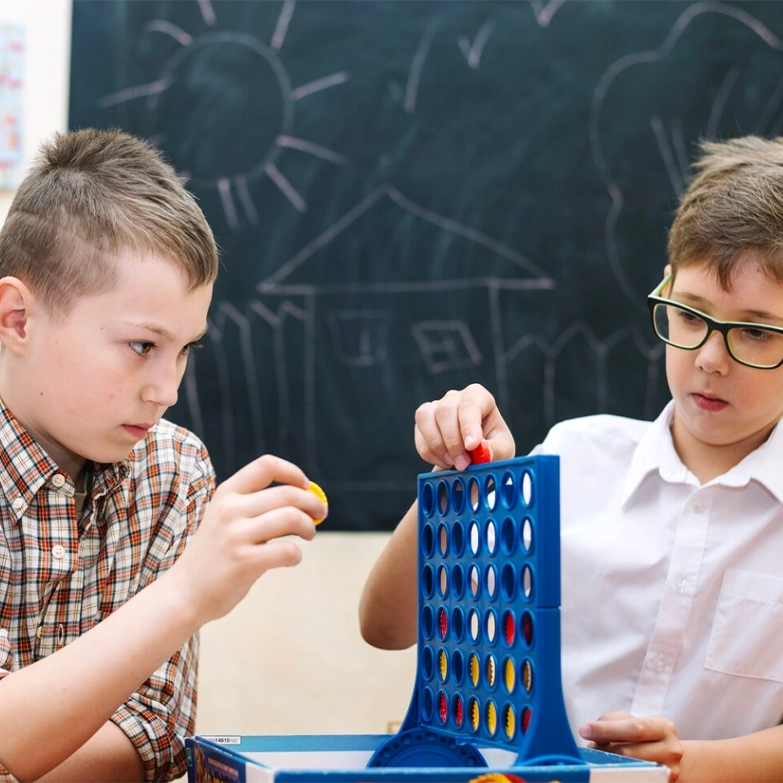
Logical reasoning games are among the most effective games for supporting mental development. These games help children establish cause-and-effect relationships and make decisions by developing their own strategies. Through activities such as block placement puzzles, visual pattern completion exercises, and tangrams, students unconsciously develop logical reasoning and understand mathematical relationships.
In addition, strategy and planning games help students develop the skills of planning, thinking of alternative ways, and implementing them to achieve a specific goal. Through these games, children learn to be patient, take steps one at a time, and develop solutions to the challenges they face. This teaching process, supported by educational games, makes math lessons both understandable and enjoyable for children.